Authored by Lisa Countryman-Quiroz, Chief Executive Officer
Summary: Jewish Vocational Service (JVS) was founded in 1973 to meet an urgent need within San Francisco’s Jewish community. More than 50 years later, the same Jewish values that shaped our founding still guide how we approach economic mobility for jobseekers of every background.
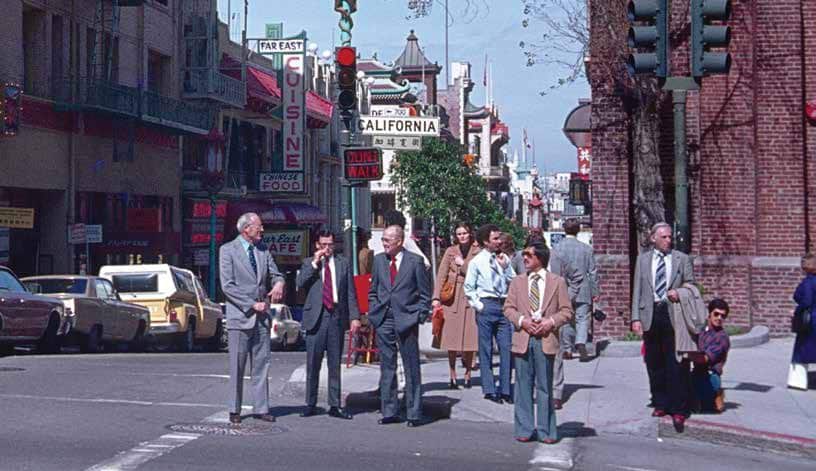
San Francisco in the 1970s
Our roots in the Jewish community
As AI reshapes the job market, it’s tempting to treat the future of work as a problem without precedent. But JVS was built to solve a version of this same challenge more than 50 years ago, when Jewish workers in the Bay Area found themselves suddenly locked out of a changing job market and the broader Jewish community stepped in to help.
Long before we became one of California’s largest workforce development nonprofits, JVS Bay Area was a two-year experiment run out of a single office on Market Street. Fifty-plus years later, our work—including the job market, the technology, and the people we serve—looks different. What hasn’t changed is the set of values underneath that work, grounded in our Jewish founding and history.
These roots are an important part of JVS’s story and helped shape an approach to economic opportunity centered on dignity, economic stability and opportunity, and strengthening community. Those values have been carried forward from one generation of JVS to the next, even as our work and the communities we serve have evolved.
How JVS began

An article in the San Francisco Jewish Bulletin announces the creation of JVS in 1973.
In early 1973, the Jewish Welfare Federation of San Francisco, Marin County, and the Peninsula identified a problem: Jewish workers across the Bay Area were struggling to find jobs, and no dedicated agency existed to help them. The Federation launched a two-year pilot program to fill that gap, naming Lawrence Lucks as executive director and Irving Rabin as board president.
The agency, then called the Jewish Vocational and Career Counseling Service, opened its doors on July 2, 1973. Seventeen people walked in that first day. By the end of the week, roughly 60 had come through in person, with many more calling by phone. Within a month, staff had counseled 160 people ranging in age from 16 to 77, from native San Franciscans to immigrants from across the globe.
From the beginning, the Jewish Career Counseling and Employment Service committed to preserving the dignity of all those who came to it for help, regardless of why they were out of work. Job placement services were offered free of charge, while career counseling and vocational testing were available on a sliding fee scale. Lawrence Lucks, the agency’s first director, committed that “no one will be denied service because of an inability to pay.”

An article in The Jewish News of Northern California announces the placing of a Mezuza on the door at Jewish Vocational and Career Counseling Service’s offices.
In September 1973, the agency held an open house at which board president Irving Rabin said: “Today we affix a Mezuza as we officially open the doors of this agency that will serve to give substance to the traditional Jewish concept that calls upon us to help a fellow man find a job or learn a trade so that he not be forced to turn to the community for charity; to strengthen our Jewish community by helping to make economically stronger the Jewish families in our community.”
That moment offers a window into the values behind JVS’s founding. Helping someone find work or learn a trade was understood as a way to uphold dignity, foster self-sufficiency, and strengthen the community—ideas that became foundational to JVS’s approach to workforce development.
Evolving to meet the moment
That founding purpose continued to evolve to meet the moment. Within five years, JVS was serving 1,200 jobseekers, 98% of them Jewish. We started offering skills training, not just counseling and job placement. In the 1980s, JVS built training programs specifically for Soviet Jewish emigres arriving with technical skills but little English, as well as for older workers who needed to learn word processing to stay competitive. During the Jewish unemployment crisis of the mid-1980s, we ran interview workshops and support groups for Bay Area professionals whose self-esteem, and sense of identity, had taken a hit along with their paychecks. Welfare reform in the 1990s spurred additional growth as JVS developed innovative programs for people coming off of public assistance. We also began working with community colleges and building foundational employer partnerships that persist today.
Expanding our reach
By the 1990s, JVS’s client base started to look different. While much of our work still focused on supporting Jewish Soviet emigres, we developed new programs to meet new needs. In 1994, we became the lead agency in a Bay Area program preparing teenagers with learning and emotional disabilities for entry-level jobs—very few of whom were Jewish. When asked why a Jewish agency would prioritize non-Jewish teenagers, then-executive director Abby Snay invoked the Jewish tenet of tikkun olam, or repairing the world, and noted that “The Jewish community is better off in a stronger general community.”
Her words captured how JVS understood its expanding role at the time: Our roots in the Jewish community could coexist with—and help inspire—a commitment to strengthening the broader community.
By 2000, JVS’s clientele had become an even split between Jewish and non-Jewish jobseekers, and today, the vast majority of the people we serve are not Jewish. That expanding reach also reflects a Jewish understanding of communal responsibility: that our responsibility to one another extends beyond our own community, and that we all benefit when our broader community is able to thrive.
As JVS has expanded and innovated to meet the most urgent needs of jobseekers in an ever-changing labor market, our commitment to Jewish values has remained an important part of our story. That’s the throughline connecting the Soviet emigre engineers we trained in the 1980s to the predominantly Black and Latinx healthcare and skilled trades workers we support today.

JVS staff collaborating on a project in the 2010s.
How our Jewish history informs our work today
JVS’s current mission—closing opportunity gaps in employment so jobseekers can secure quality careers with family-sustaining wages—reflects values that have been present throughout our history, including dignity, justice, learning, and a responsibility to strengthen community.
More than 50 years after a mezuzah was affixed to the door of our first office, JVS Bay Area looks very different than it did in 1973. Our reach has expanded, the communities we serve have evolved, and the labor market has transformed. But we remain proud of our Jewish roots and the role they have played in shaping our history, our approach to economic opportunity, and the organization we are today.
JVS Board President Erran Berger has said that “JVS’s commitment to aiding individuals in achieving self-reliance and financial well-being embodies the treasured Jewish ideal” of tzedakah—a Hebrew word that translates to “righteousness” or “justice” but is often synonymous with “charity.” Longtime civic leader and former board president Lynn Bunim has described investing in JVS as “a meaningful and fulfilling way I demonstrate my personal commitment to tikkun olam,” a phrase that means “repairing the world.” Their framing reflects how members of the JVS community have connected our work to Jewish values in their own lives.
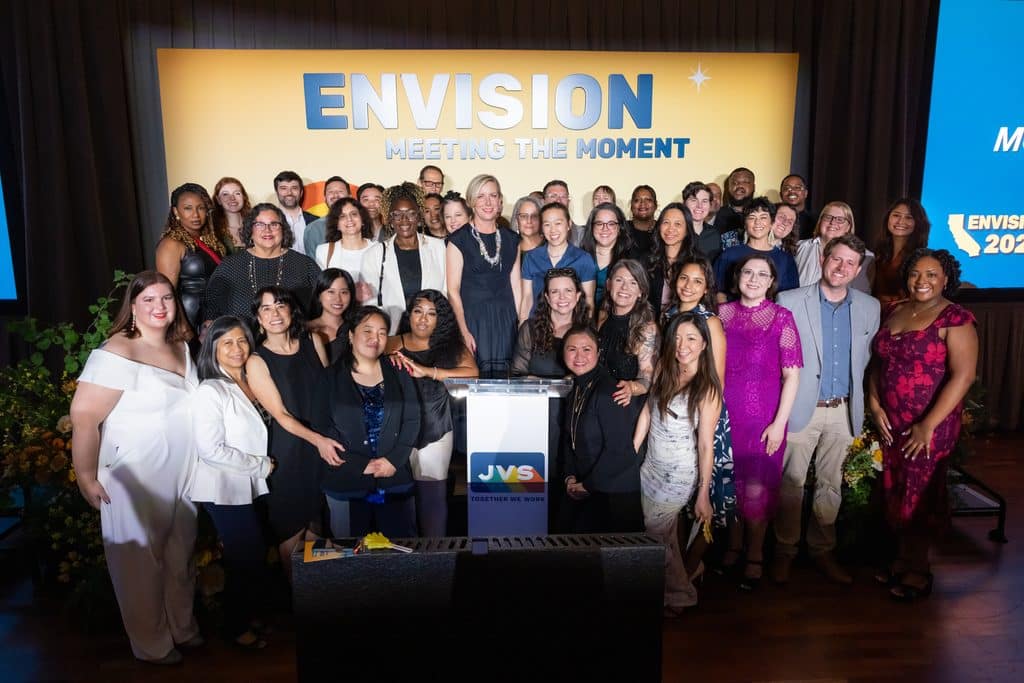
JVS staff at the 2026 Envision gala.
Carrying our history forward
The Jewish concept of l’dor v’dor, or “from generation to generation,” speaks to the responsibility to carry values, learning, and community forward while adapting them for a new generation. In many ways, that is part of JVS’s story, too. The people we serve and the challenges they face have changed dramatically since 1973, but the values that shaped our founding continue to inform how we respond to each new moment.
There’s a quote attributed to Rabbi Hillel that’s guided this organization since before it had a permanent office: “Do not separate yourself from the community…do not judge your fellow human until you have reached that person’s place.” Fifty-plus years in, its message of empathy and responsibility to community still guides our work, whether we’re training a water treatment operator in the Inland Empire or a medical assistant in Sacramento.
As we look ahead, we carry that history forward, honoring where JVS came from while continuing to evolve to meet the needs of the diverse communities we serve.
Explore ways to give, or stay connected by signing up for our supporter newsletter.