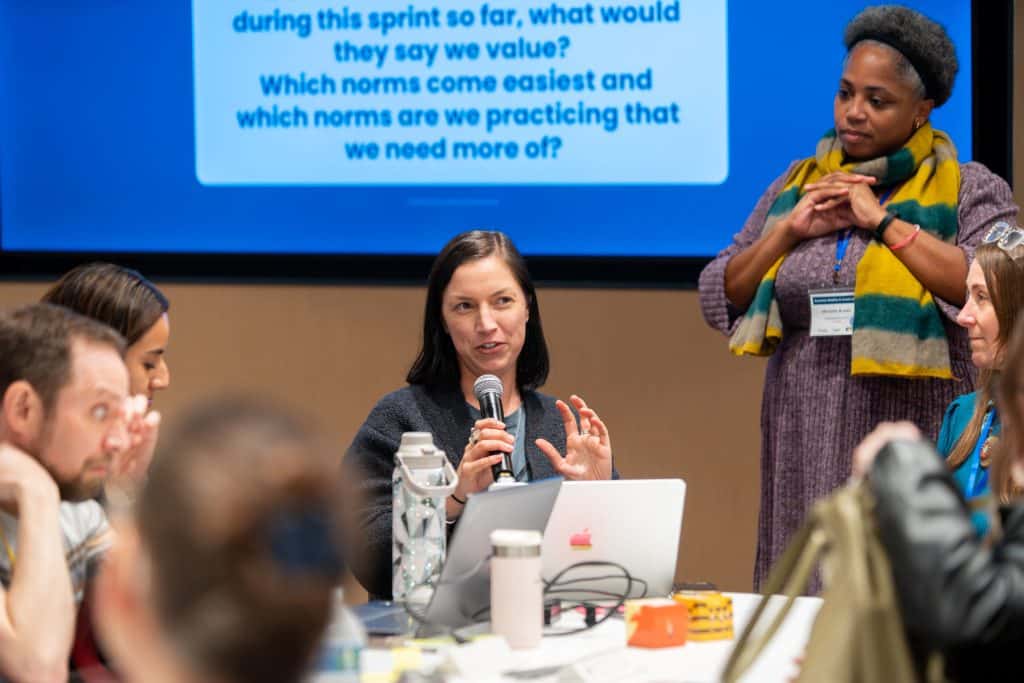


Participants at the Economic Mobility AI Accelerator Design Sprint shared learnings and collaborated on projects on Day 1 of the event.
As AI rapidly reshapes the labor market, workforce development organizations are exploring how new technologies can be used to expand, rather than limit, economic mobility. The Economic Mobility AI Accelerator brings together leaders from across the workforce sector to explore practical ways AI can strengthen how organizations support jobseekers.
On February 25-26, JVS hosted the in-person design sprint for the cohort, assembling a group of over fifty workforce practitioners and funders from across California. For the previous three months, the participants brainstormed and designed AI solutions to improve economic mobility outcomes at workforce organizations.
The accelerator is organized by JVS in partnership with Arathi Ravier Consulting, Leading Educators and Playlab, bringing together practitioners, technologists, and funders to explore practical applications of AI in workforce development.
The design sprint marked a shift from exploration to action. Teams worked through real operational challenges inside their organizations—prototyping tools, pressure-testing use cases, and identifying where AI can meaningfully improve how workers navigate fragmented systems, access services, and move into quality jobs.
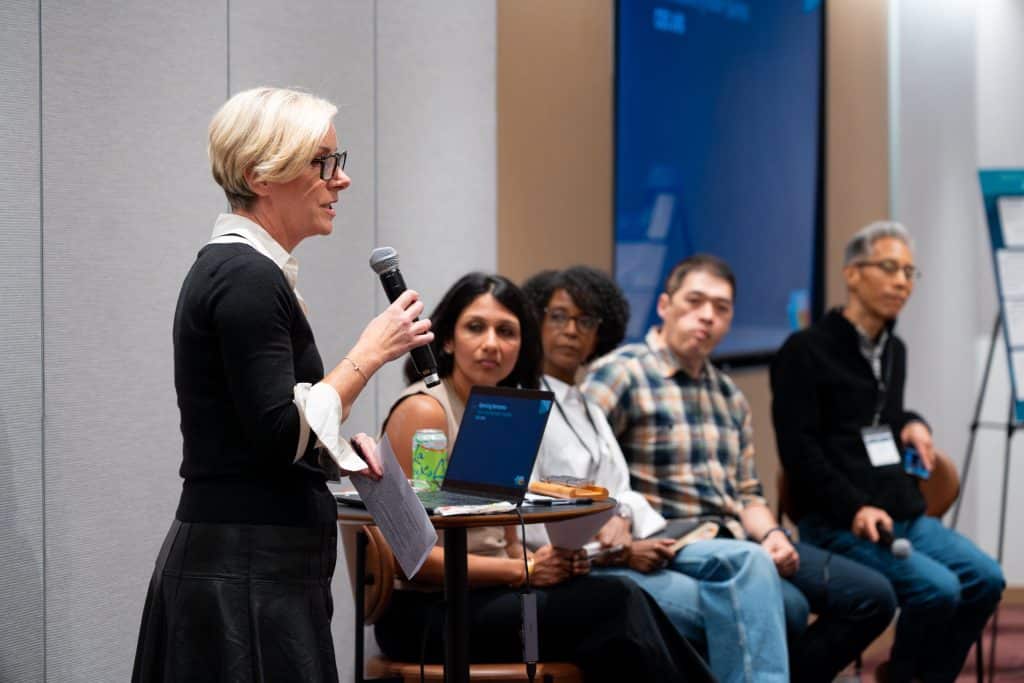
From left: JVS CEO Lisa Countryman-Quiroz introduces a panel composed of moderator Arathi Ravier and panelists Alexandra Bernadotte, Jared Chung, and Steve Lee on Day 2 of the Design Sprint
Participants left with several key reflections:
- The real innovation is happening inside frontline organizations. Workforce practitioners understand the constraints workers face and where systems break down, which makes them uniquely positioned to design practical AI applications.
- The opportunity of AI is less about replacing human services and more about scaling them. Many of the most promising ideas focused on using AI to extend the reach of trusted intermediaries, helping workers navigate complex training, benefits, and employment systems.
- The sector is ready to move from conversation to experimentation. There is growing appetite among workforce organizations to build and test tools themselves, rather than waiting for technology vendors to define the solutions.
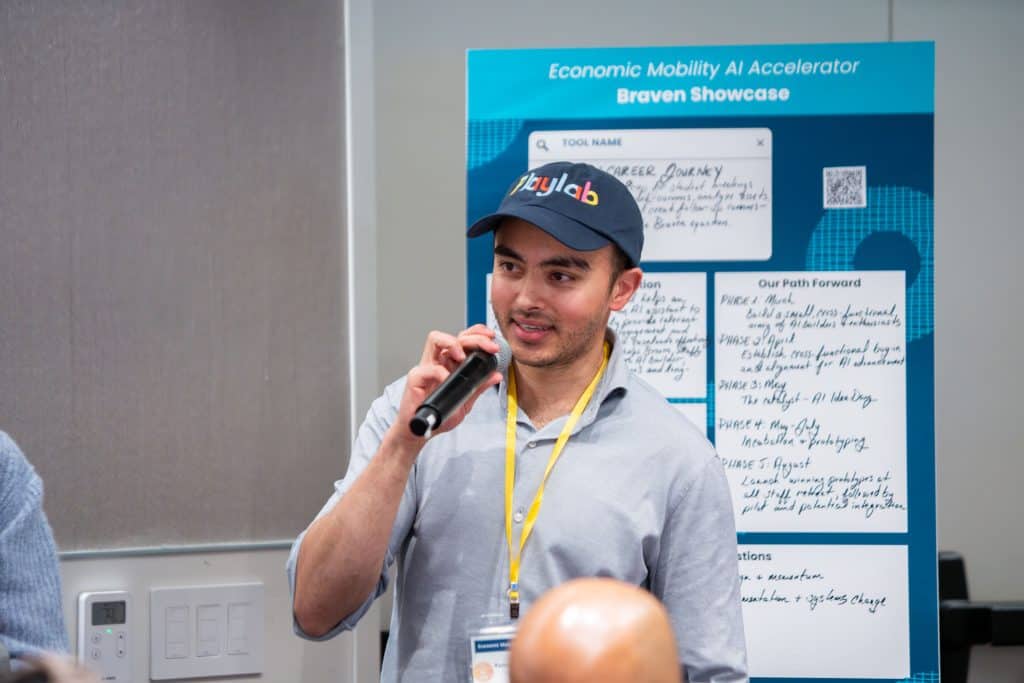


Attendees shared insights and heard from industry leaders during the Design Sprint.
Eighteen organizations make up the Economic Mobility AI Accelerator cohort advancing their capacity to understand and apply emerging technologies within the workforce development sector:
- JVS Bay Area
- Merit America
- Opportunity Junction
- Canal Alliance
- JVS SoCal
- JobTrain
- Center for Employment Opportunities (CEO)
- Braven
- First Place for Youth
- Rivet School
- Building Skills Partnership
- La Cocina
- EDVance
- Growth Sector
- Upwardly Global
- Per Scholas
- Step into a Job! (BAMA)
- Opportunity @ Work
The next phase of the accelerator will focus on continuing to prototype, test, and share what organizations are learning about how AI can be applied in ways that expand—rather than erode—economic mobility.
The Economic Mobility AI Accelerator is made possible thanks to our collaborators at Leading Educators and Playlab, with funding provided by Crankstart, Tipping Point, Salesforce, Google, and Anthropic.
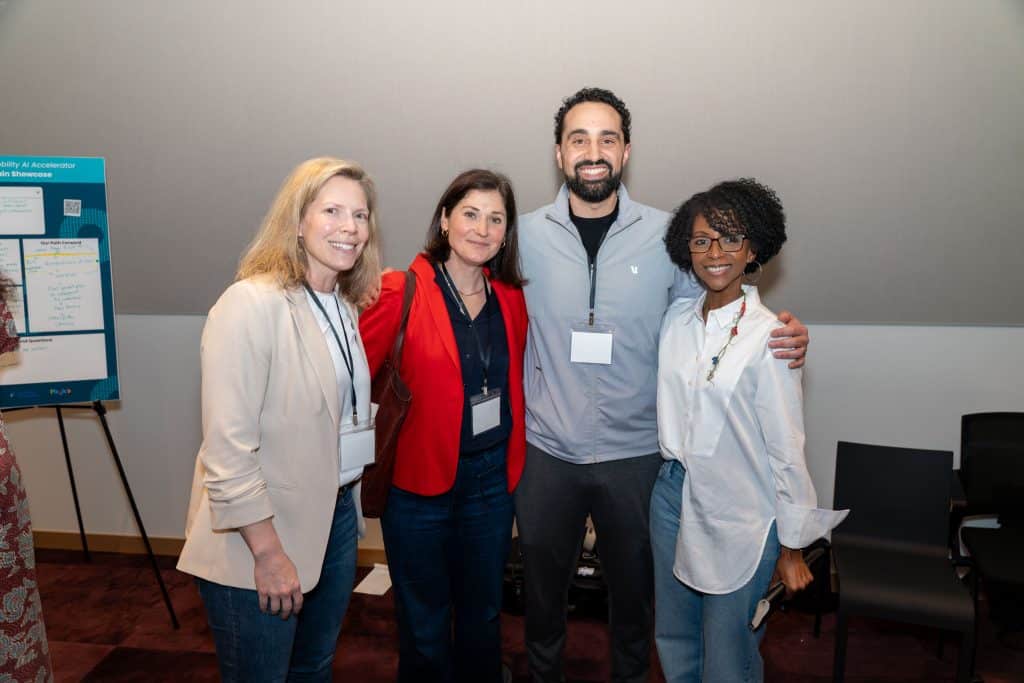


Workforce development practitioners and funders gathered on Day 2 of the Design Sprint to share learnings and opportunities for future collaboration.
Workforce development organizations interested in scaling AI tools to strengthen their capabilities can express interest in future cohorts of the Economic Mobility AI Accelerator by contacting Nikkol Kinoshita, JVS Assistant Director of Executive and Operations Projects, at nkinoshita@jvs.org.